
Manual.ly Logo

Carson Tyrann Single Blade 320 Handleiding

0,0 · 0 Beoordelingen

PDF handleiding · 32 Pagina's

Nederlands

M: QW-35-FL
pagina

/ 32

Loading...
72334901dea92b602cd5abd09530e28c6e51 page d
13 // GB
Make sure that you have sufficient insurance cover when practising your hobby or take
out a special insurance for model aircraft. The contact address for this is Deutscher
Modellfliegerverband e.V. Rochusstr. 104 – 106, 53123 Bonn.
Only a well-maintained model will function properly. Only use approved spare parts and never
improvise with any unsuitable items.
It is the user’s responsibility to ensure that the model is functioning correctly and that all nuts,
bolts and screws are tightened.
Keep the model well beyond the reach of small children. They may unintentionally activate the
model and cause themselves injury with it, or they may put batteries and small parts into their
mouths and swallow them.
Preparations
Never start flying before you have made sure of the following points:
• Pay attention to visible damage on the model, remote control, battery charger, and lithium
battery.
• Ensure that the model is functioning correctly and that all screwed and plugged connections
are fitted precisely and tightly.
• The flight battery must be fully charged and correspond to the correct voltage. Only use
new/fresh batteries for the transmitter.
• Make sure that all servos respond correctly to the signals of the transmitter.
• Always check the radio operation before starting the model.
Flight operation
The model is primarily designed for indoor flights since its low weight and unstable flight
position resulting from the construction type make it very susceptible to air movements.
Moreover, the components are not dust- and moisture-proof.
Do not fly any longer than one battery charge
Afterwards, the model must cool down for at least 5 minutes.
Then recharge the battery. Avoid deep discharge in any case.
General information
• If you have little or no experience with model aircraft you should practice with a flight
simulation program first.
• Ask experienced model pilots for advice with the fine settings of your model aircraft.
• Familiarise yourself with the control functions of your trnasmitter.
• Start your first flights, standing behind the model and looking in the flight direction. In this
case, the control reaction equals the controlling direction.
• Also familiarise yourself with the movements of the model, when it flies towards you
(response opposite to the control direction)!
Safety Precautions Lithium batteries:
1. General: Lithium batteries (accumulators) are energy storage devices with a high energy
density and can present risks. For this reason, particular care is needed when charging,
discharging, storing and handling. Read these instructions very carefully before first using the
battery. Do not fail to take note of the warning notices and instructions for use. Misuse can lead
to risks such as explosion, overheating or fire. Failure to observe the instructions for use leads to
early failure and other defects. The instructions should therefore be kept in a safe place and it is
essential that they are handed over to the second user if the batteries are passed on.
2. Warning notices:
• Avoid short-circuits. A short-circuit may well destroy the product. Cables and connections
must be well insulated.
• It is essential when connecting the battery to ensure that the polarity is correct.
• Original plug connectors and cables may not be cut off or changed - if need be, use an
adapter cable.
• Do not expose the battery to excessive heat or cold or to direct sunlight. Do not throw in the
fire. Do not place the battery in contact with water or other liquids.
• Charge the battery only with charging units intended for the purpose and always use the
balancer connection. It is only by using the balancer connection that optimum charging can
be ensured. If this connection is not used, charging is subject to the risks mentioned above.
Before charging, always first allow the battery to cool to ambient temperature. Never charge
while hot.
• When charging, place the battery on a non-flammable, heat-resistant support. There should
be no flammable or readily ignited objects in the vicinity of the battery.
• During charging or operation, never leave the battery unsupervised.
• Do not fail to keep to the recommended charge/discharge current.
• The battery casing must not be damaged. It is essential to avoid damage by sharp objects
such as knives or the like, from dropping, impact, bending etc. Damaged batteries may no
longer be used.
• Batteries are not toys. They should be kept away from children.
3. Charging instructions: Lithium batteries are charged according to the CC-CV procedure.
CC stands for “constant current“, which is applied during the first phase of charging. Once the
battery reaches the maximum voltage configured in the charger, it switches to CV (constant
voltage) for the second phase of charging. The battery voltage no longer increases. The charging
current now falls continuously until the battery is fully charged. The maximum charging current
for the battery is 1C (C=nominal capacity of the battery, e.g. for a battery with a nominal
capacity of 2700 mA, the maximum charging current for the battery is 2700 mA (2.7 A)). Never
charge several batteries together from a single charger. Differing states of charge and capacities
can lead to overcharging and destruction.
4. Storage instructions: Lithium batteries should be stored charged to 20-50 % of their
capacity and at a temperature of 15-18 °C. If the cell voltage falls below 3 V, they should be
recharged. Deep discharge and storage when discharged (call voltage <3 V) will render the
battery unusable.
5. General terms of guarantee: There is a legal guarantee for production and material faults
as applicable at the time of dispatch. No liability is accepted for normal wear and tear. This
guarantee does not apply for defects attributable to improper use, inadequate maintenance,
third-party interference or mechanical damage. This applies, in particular, to used batteries
and batteries clearly showing signs of use. Damage and loss of performance due to improper
handling and/or overload are not product faults. Batteries are consumables and subject to a
certain ageing. This is influenced by factors such as the charge/discharge currents, the charging
procedure, the operating and storage temperatures and the state of charge during storage.
The ageing shows itself in, among other things, an irreversible loss of capacity. In the model
field, where batteries are frequently used to supply motors, very high currents can flow from
time to time.
6. Exclusion of liability: Since we are unable to have any control over charge/discharge, handling,
compliance with assembly and operating instructions, battery replacement and its care and
maintenance, Tamiya / Carson can accept no liability for loss, damage or costs incurred. Any claim
for damages that may result from operation, failure or faulty operation or that is in any way related
thereto will therefore be refused. We accept no liability for personal injury or material damage and
their consequences that arise from our delivery.
7. Disposal instructions: Batteries are hazardous waste. Damaged or unusable cells must be
disposed of in the correct manner.
No liability for printing errors, we reserve the right to make changes!
SAFETY PRECAUTIONS LITHIUM BATTERIES

Chat met je Carson Tyrann Single Blade 320-handleiding via AI

Krijg direct AI-antwoorden uit je Carson Tyrann Single Blade 320-handleiding

Vraag alles over Carson Tyrann Single Blade 320. Antwoorden komen uit deze handleiding, met de pagina's waarop ze zijn gebaseerd.

Tyrann Single Blade 320 Onderhoudsschema

Voor elke vlucht
Controleer het model op zichtbare schade

Controleer het model, de afstandsbediening, de oplader en de accu op zichtbare schade voor elke vlucht.

Voor elke vlucht
Draai alle schroeven en verbindingen vast

Zorg ervoor dat alle geschroefde en gestoken verbindingen nauwkeurig en stevig zijn bevestigd voordat u vliegt.

Voor elke vlucht
Verifieer servo reactie

Zorg ervoor dat alle servo's correct reageren op de signalen van de zender voordat u het model start.

Voor elke vlucht
Controleer radiobereik

Controleer altijd de radiowerking en het bereik voordat u het model start.

Na elke vlucht
Laat het model 5 minuten afkoelen

Vlieg niet langer dan één acculading. Laat het model daarna minimaal 5 minuten afkoelen.

Zo nodig
Vervang beschadigde propellerbladen

Beschadigde propeller- of rotorbladen moeten onmiddellijk worden vervangen. Probeer ze niet te repareren.

M: qwen/qwen3.8-flash

Stel eenVraag

0/1000

Beveel je Tyrann Single Blade 320 aan?

Ja Nee

Veelgestelde Vragen

A

Er is een 24-maanden garantie tegen fabricagefouten geldig vanaf de aankoopdatum bij een geautoriseerde dealer.

Is dit antwoord nuttig?

A

Het is ontworpen voornamelijk voor binnen gebruik. Buiten vliegen vereist geen wind om verlies van controle door het lichte gewicht te voorkomen.

Is dit antwoord nuttig?

A

De LiPo-batterij duurt doorgaans een tot twee uur om volledig op te laden met behulp van de meegeleverde USB-lader.

Is dit antwoord nuttig?

A

Kinderen onder zestien jaar moeten alleen bedienen onder toezicht van volwassenen aangezien het niet wordt geclassificeerd als een speelgoed.

Is dit antwoord nuttig?

A

Laat de motor minimaal vijf minuten afkoelen voordat u probeert het model weer te vliegen.

Is dit antwoord nuttig?

A

Ja, u kunt schakelen tussen Modus 1 en Modus 2 met behulp van de zenderinstellingen voordat u opstijgt.

Is dit antwoord nuttig?

A

Verzekering is vaak wettelijk vereist voor radio-gecontroleerde vliegtuigen vanwege de operationele risico's.

Is dit antwoord nuttig?

M: QW-35-FL

Voordelen en Nadelen

Voordelen

  • Klaar om te vliegen uit de doos zonder montage
  • Ingebouwde gyro voor stabiel vlieggedrag
  • LED-verlichting verbetert zichtbaarheid tijdens vlucht
  • Bevat automatische start- en landingsfunctie
  • 2.4 GHz bediening voorkomt verstoring
VS

Nadelen

  • Ontworpen voornamelijk voor binnen gebruik vanwege windgevoeligheid
  • Korte vliegduratie per enkele batterijlading
  • Vereist volwassen toezicht voor gebruikers onder 16
  • Motor vereist koeltijd tussen gebruiksessies
  • Verzekering vaak verplicht voor bediening
M: QW-35-FL

Product Specificatie

Type

Helikopter

Frequentie

2,4 GHz

Aandrijving

Elektromotor

Vliegtijd

18 min

Afmetingen

32,00x24,99x8,00 cm (LxBxH)

Gewicht

53,01 g

M: QW-35-FL

Product Beschrijving

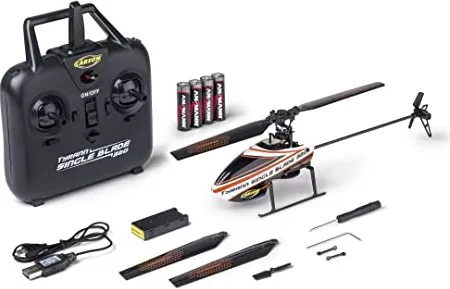
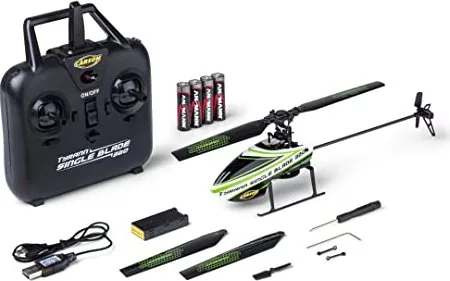
Ervaar het Vliegvermaak met de Carson Tyrann Single Blade 320

Het aanschaffen van een nieuw model op afstand besturen is altijd een spannend moment voor hobbyisten die de lucht willen verkennen. De Carson Tyrann Single Blade 320 onderscheidt zich als een robuuste intrede in de wereld van luchtrobotiek. Dit apparaat is ontworpen voor onmiddellijk gebruik en komt klaar om te vliegen, direct uit de doos, zonder dat ingewikkeld schroefwerk nodig is. Gebruikers waarderen het gemak van de complete assemblage wat de opsettijd aanzienlijk minimaliseert. U kunt alle benodigde technische details en precieze instructies vinden door te verwijzen naar de Carson Tyrann Single Blade 320 Handleiding die in het pakket wordt gevoegd om ervoor te zorgen dat het model elke keer correct wordt bediend. Het 2.4 GHz bedieningssysteem garandeert een stabiele verbinding tijdens uw vluchten zonder verstoring. Het bevat functies zoals automatische hoogtecontrole en een ingebouwde gyro voor stabilisatie. Dit maakt de leercurve veel soepeler in vergelijking met oudere borstelloze modellen. De LED-verlichting maakt betere zichtbaarheid mogelijk, vooral tijdens het vliegen tijdens schemering of in omgevingen binnen met weinig licht. Daarnaast biedt de zender Modus 1 en Modus 2 instellingen, waardoor piloten hun voorkeurs gasklepconfiguratie kunnen kiezen voor rechtshandige of linkshandige bediening.

Veiligheid is van groot belang bij het bedienen van elk vliegend apparaat. Het ontwerp is het beste geschikt voor omgevingen binnen omdat de lichtgewicht constructie het zeer gevoelig maakt voor buitenwindcondities. Gebruikers worden geadviseerd het apparaat te bedienen in ruime kamers vrij van obstakels zoals meubels. Tijdens het vliegen, zorg ervoor altijd dat u zich op een vlak oppervlak bevindt en bewaakt de batterijniveaus nauwkeurig om valpartijen te voorkomen. De meegeleverde LiPo-batterij vereist specifieke laadprotocollen om levensduur te behouden en veiligheidsrisico's tijdens laadcycli te voorkomen. Zorg ervoor dat alle schroeven en verbindingen strak zijn voordat u probeert te vliegen om stabiliteit te behouden. Batterijspanning moet overeenkomen met juiste specificaties voor optimaal zendbereik. Als het model niet reageert op commando's, controleer eerst de batterijspanning. Motoroververhitting duidt op een behoefte aan een koelperiode voordat verdere gebruik. Vlieg niet bij windkracht groter dan één om controle te behouden.

Belangrijke Onderhoudsnotities

Regelmatige controles van de rotorbladen en servo-respons zijn essentieel voor veilige bediening elk seizoen. Vervang altijd beschadigde propellers onmiddellijk om instabiliteit tijdens hover-modi te voorkomen. De garantie dekt fabricagefouten gedurende twee jaar als gekocht van een geautoriseerde dealer. Wees ervan bewust dat verzekering vereist is voor bediening zoals per lokale wettelijke richtlijnen met betrekking tot besturingsvliegtuigen. Vermijd diepe ontlading van de batterijcellen om de totale levensduur te verlengen. Houd het model buiten bereik van kleine kinderen onder zestiën jarige leeftijd. Volg altijd de richtlijnen die in de documentatie worden gevonden om geen garantieclaims te laten vervallen. Laden duurt ongeveer een tot twee uur met behulp van de USB-lader. Herlaad alleen als het model volledig is afgekoeld om schade aan de lithiumcellen te voorkomen.

M: QW-35-FL

© Copyright 2026 Manual.ly